Non-Euclidean space
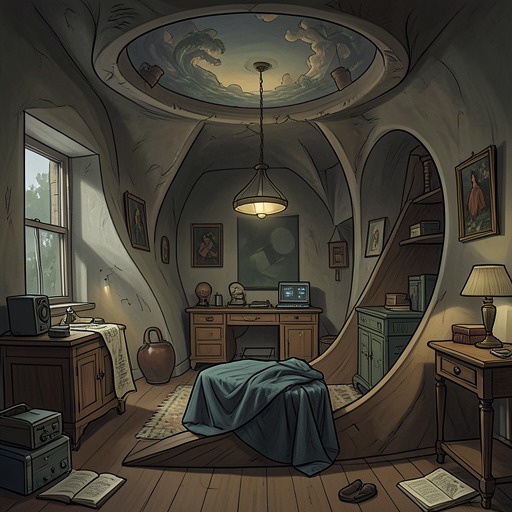
You Should Have LeftNon-Euclidean space is the governing spatial condition of the Vacation House: a reality in which familiar geometry remains outwardly recognizable but no longer behaves consistently. Its decisive significance is that it turns the narrator’s attempt to measure and document the world into evidence of the world’s instability. The house is not merely frightening because it contains something hostile; it is frightening because its location has made ordinary relations between rooms, distances, surfaces, reflections, and exits impossible to trust.
Definition and First Signs
The condition becomes legible through the triangle ruler bought at Gruntner's General Store. After copying down Susanna’s messages, the narrator uses the ruler to draw a straight line, a right angle, and a bisecting line. The drawing looks peculiar, and measurement produces an impossible result: the right angle is still ninety degrees, yet the two component angles measure forty and forty-two degrees, leaving several degrees apparently unaccounted for. Repeated measurement does not resolve the contradiction. When he constructs further right angles and completes them into a rectangle, the same failure returns in altered form: the angles that should be bisected measure forty-nine and fifty-one degrees.
The ruler is important because it briefly appears to offer an external test of reality. The narrator checks its scale, holds it up to the light, and shuts one eye; nothing seems defective, and no numbers are missing. The discrepancy therefore cannot be dismissed as a damaged instrument. At the same time, the drawings resist stable perception. Their lines become blurry, and the narrator’s gaze glides over them whenever he stops forcing it to remain fixed. Geometry here is not simply incorrect. It is visibly present and internally coherent enough to be measured, yet its parts refuse to belong to the whole in the expected way.
The explanation supplied by Fehringer connects the measurements to a larger local understanding. Speaking of the angles above the house, he says that they do not fit together. He attributes the idea to Hans Ägerli, who compares human comprehension with that of an ant confronted by a cathedral, a power plant, or a volcano. The comparison does not explain the mechanism, but it establishes a limit of scale and conception: the narrator may be encountering a structure that cannot be represented adequately within the conceptual language available to him.
Spatial Operations
The anomaly becomes unmistakable when the narrator attempts to leave the house with Esther. His phone shows no network, and he takes Esther by the hand, unlocks the door, and leads her out. The apparent exit does not open onto the outdoors. Esther squeals because they are back in the living room, even though they have genuinely left that room and passed through a door. The route has folded back onto its point of departure, converting an ordinary architectural passage into a closed spatial circuit.
The narrator responds by changing not the destination but the manner of movement. He tells Esther that they must not turn around and makes the escape a game as they walk backward. They reach the hall, where he sees the washing-machine room and a half-open door that he does not remember being there before. Inside is an empty room with a naked lightbulb and a wooden chair missing a leg. He feels a powerful desire to enter but resists it and pulls Esther onward. The abnormal space therefore operates through both geometry and temptation: it alters the building’s arrangement while presenting thresholds that invite further penetration.
The backward route appears to succeed only temporarily. After carrying Esther through the woods, the narrator sees what seems to be the outside world opening before him: tree trunks, a road, and the light of a house. Yet the building ahead has the pointed roof, wide front door, empty parking area, long table, kitchen, and open hall door of the Vacation House. The effort to cross from the house into the surrounding landscape has returned him to the same structure. Movement away from the anomaly becomes another path through it.
Inside, the spatial disturbance proliferates. The previously empty room appears to contain another door, behind which is another empty room with the same lightbulb and open doorway, followed by a third. The narrator sees this only briefly and is uncertain whether something moved on the floor of the third room, but the repetition is itself significant. Rooms no longer form a finite sequence leading toward a stable exterior; they reproduce one another as if depth had become recursive. A man appears briefly on the ceiling rather than the floor, looking down as though asking for help. His position makes orientation itself unreliable, while his resemblance to the woman with the narrow eyes suggests that the house’s inhabitants or apparitions may belong to the same distorted spatial order.
Reflections, Records, and Unreliable Verification
Non-Euclidean space also disrupts the surfaces through which the narrator tries to verify experience. Earlier, a window reflection imitates his actions: when he sits, the reflection sits, and when he writes, the reflected figure writes as well. When the strange repetition stops, he looks away to find his phone and take a picture; when he turns back, he is in the room, seated before the pane as though the reflected space has become his own. He records the event in his notebook because he fears that memory will immediately recast it as imagination. The record is meant to preserve reality, yet even while writing he begins to suspect that the event was imagined.
The notebook and the phone thus become competing supports for consciousness. The narrator relies on writing to remember, on the ruler to measure, on the phone to photograph and communicate, and on the building’s doors to establish direction. Each support becomes compromised. The phone loses its network when he needs help, and the notebook later appears on the table in a room whose reflection contains no person. The image is especially destabilizing because the reflected room is otherwise clear: rain lines mark the window, and the long table, cabinet, kitchen, and door can all be seen, but no one stands within the reflected space. The notebook remains as a trace of thought after the human figure has vanished from the image.
The house itself seems to shift between presence and absence. It is a new, minimalist, architect-designed building with two stories, a narrow upper balcony, and a large living-room window, and it initially looks better in reality than in its Internet photographs. Its apparent modern clarity makes the later distortions more severe. A framed photograph of a somber, bearded man appears beside the kitchen cabinet even though the narrator remembers recording that there were no pictures anywhere in the house. The issue is not merely whether he overlooked the photograph. His written inventory, the physical room, and his present perception no longer agree, so documentation becomes another surface on which the spatial anomaly registers.
Cosmic Model and Consequences
The narrator eventually stops treating the phenomenon as a flaw in the house’s construction. He concludes that it is the place itself, not the building: the house is harmless and is simply standing where nothing should stand. This distinction separates agency from location. The structure need not be alive or malicious to become dangerous; its position has exposed it to a region where ordinary spatial rules are thin. He imagines other such places on the sea bottom or in untouched mountain caves, perhaps separated by light-years in an infinite universe.
His developing model extends beyond the familiar three dimensions. He understands the angle problem as requiring additional dimensions imagined from the other side, or from within, though he admits that ordinary words cannot convey the experience. The mathematical contradiction is therefore not an isolated optical trick but the visible edge of a larger ontological change. What looks like a missing few degrees in a right angle becomes a sign that the narrator is perceiving a structure whose dimensions exceed the language and senses with which he attempts to describe it.
This state transforms domestic space into a threshold between incompatible realities. The Vacation House remains recognizably furnished and navigable: there are rooms, doors, a hall, a living room, a table, a kitchen, and a window. Yet these familiar elements no longer guarantee ordinary relations. A door can lead back to the room just left; a corridor can contain repeating rooms; a ceiling can function as a floor; a forest path can return to the house; and a reflection can preserve the room while omitting the person who occupies it. The ordinary and the impossible coexist without a stable boundary between them.
Narrative and Thematic Significance
The spatial condition also reshapes the narrator’s mental and narrative authority. He is already anxious about driving, especially on the steep road of hairpin bends leading down to the village, where panic, blinding sunlight, and the absence of barriers make orientation physically precarious. The mountain road provides an initial version of a world in which a small error can move someone from everyday life to catastrophe. The Vacation House intensifies that condition until no amount of caution, measurement, or slow movement can restore a dependable route.
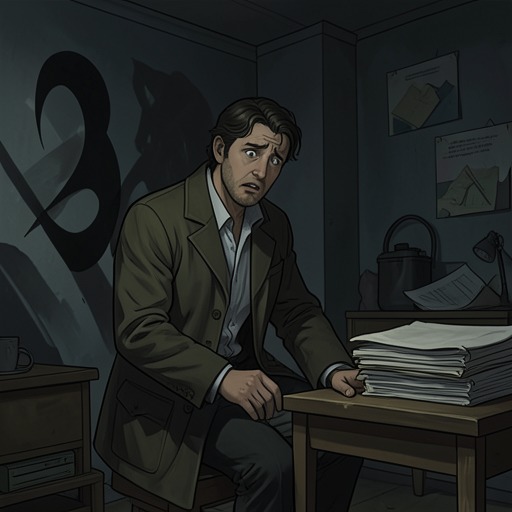
The repeated attempts to record, measure, photograph, call, and navigate create a distributed system of verification that steadily fails. His notebook preserves contradictions without resolving them; the triangle ruler confirms impossible angles; the phone cannot find a network and later carries only a stored film for Esther; doors deny the distinction between departure and return; and reflections reproduce or erase the observing subject. The collapse is therefore epistemological as well as physical. The narrator cannot establish where he is by consulting either his instruments or his memories because both have become part of the anomaly.
At the same time, the condition gives the narrative its characteristic tension between explanation and incomprehension. The narrator invokes physics, infinite universes, additional dimensions, and the image of an ant before a cathedral, but none of these formulations domesticates what is happening. They mark the effort to construct a conceptual map after the map has ceased to correspond to the territory. Non-Euclidean space is finally not a puzzle that can be solved from outside. It is the form taken by a world in which outside itself has become inaccessible, and in which the last apparent certainty is that the house stands in a place where a house should not stand.